
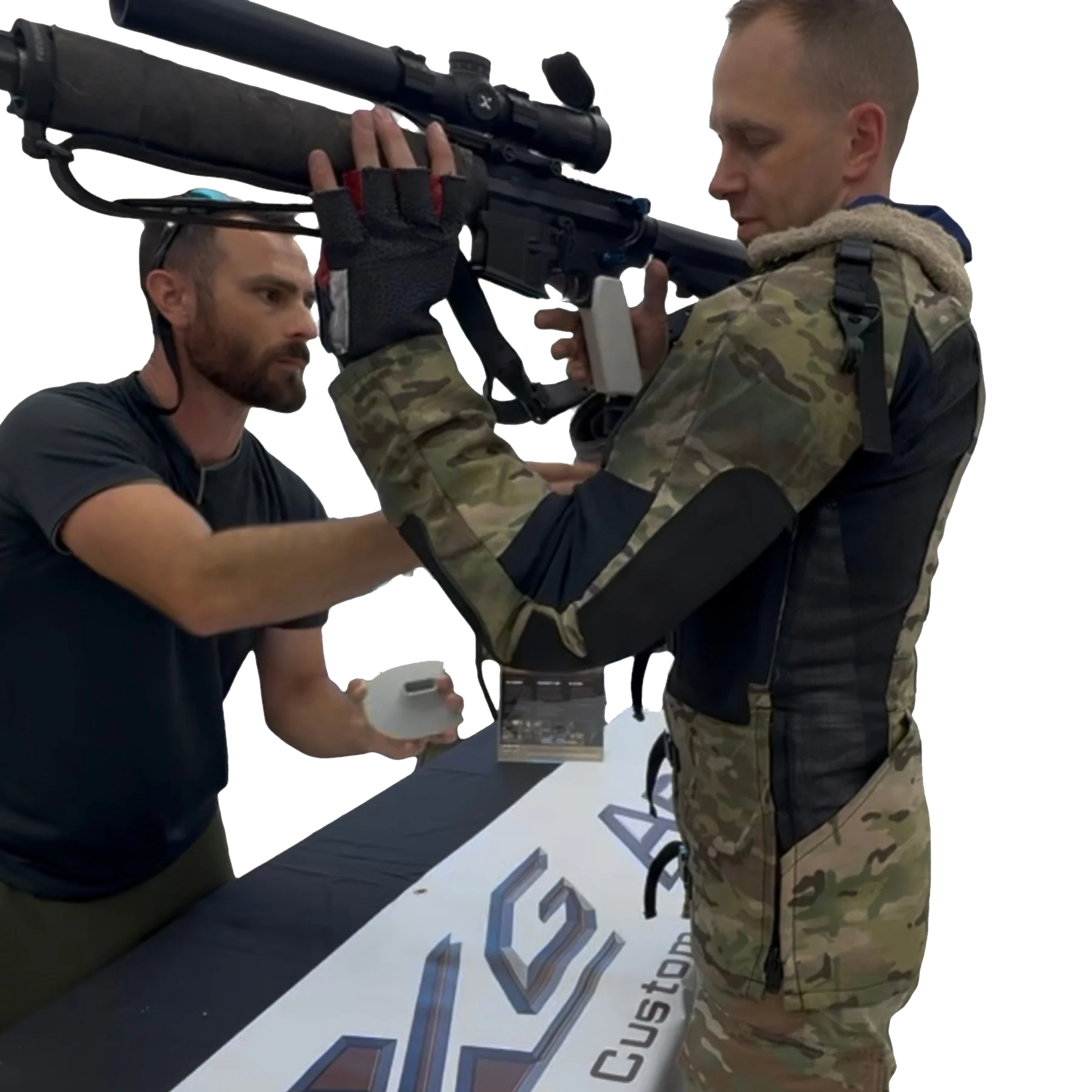
The thesis
Remove slop. Make the hold automatic.
A custom-molded grip fitted to your hand improves accuracy, trigger, recoil, and endurance the same way: it fills the gaps a Magpul, BCM, or A2 leaves, and it parks your hand in the same seat every time you pick the rifle up. You stop hunting for the grip. The rifle fits you.
Joseph von Benedikt put the human problem in print for Petersen’s Hunting: a grip that actually fits “positions the shooting hand and wrist torque-free, eliminating muscle tension that can disrupt accuracy,” and “a tension-free grip makes it easy to address a trigger consistently, shot to shot.” His line on the whole rifle: “the less human inconsistencies we impart to the rifle, the better.” [6]
That is the human element the other upgrades never touch. Glass does not hold the gun. A Geissele does not index your palm. A barrel does not stop your fist from rolling on the break. PrecisionFit is the interface those parts still have to go through.
01 Accuracy
Same place. Every time.
Your hand sits in the exact same place every time with no gaps or shifting. That cuts the small twists and extra movement when the shot breaks, so the rifle tracks more consistently. A generic grip leaves air. Those gaps become thousandths of movement at the receiver, and a miss at distance.
Army rifle doctrine frames the shot as a process you have to keep still: point the weapon, then fire it without disturbing the aim. Pre-shot is position, natural point of aim, and hold stability. The shot is refinement and trigger. Post-shot is follow-through and recoil management. [1] [3]
The CMP’s fundamentals start the same way: maximum rifle stability, then rifle-target alignment, then shot control, with muscle relaxation, not a crush. [8] If the grip is an average of millions of hands, you make up the difference with muscle. Muscle is not a rest. PrecisionFit is scanned from the mold you make of your actual firing grip, so the contact points, palm, web, and fingers, are the same pocket every round. Point of impact stops changing because you grabbed it a little different.
02 Trigger
Finger independent. Rest of the hand locked.
The grip isolates the trigger finger so it sits in the same spot and can move alone every shot. The rest of the hand stays put. That keeps the pull consistent instead of the whole hand tightening or rolling as you press.
This is not NXG language first. It is doctrine. Infantry magazine, Fort Benning: trigger control is finger placement, squeeze, and reset. That is “gripping the weapon so the finger naturally falls across the trigger.” There is no official spot on the finger. “The correct position varies from Soldier to Soldier.” Squeeze is smooth pressure until it fires. Speed matters less than not yanking the gun. [2]
The NRA says the same in fewer words: grasp firmly, as in a handshake. The finger must press straight back. Pull smoothly, without disturbing your hold. [4] Army Reserve marksmanship calls out the failure modes by name: flinch, pre-ignition push, and other unintended movement during the shot. [3]
When the whole hand helps the trigger, instructors call it milking. A Girl & A Gun describes it clean: gripping fingers have to hold pressure while the trigger finger works independently. When the fist clenches with the press, shots walk. [7]A stock A2 or Magpul that does not fill your hand is why people death-squeeze. They crush it to kill the slop. PrecisionFit fills the slop, so a handshake hold is enough and the finger can work alone.
03 Recoil
Straight back. Faster second shot.
More surface contact and better alignment send recoil straighter back instead of letting the rifle torque in the palm. You also do not have to squeeze as hard just to keep control, so there is less extra muscle fighting the shot. Sights return. Follow-up starts from the same pocket.
On Snipers Hide, the firing-hand write-up puts recoil on a line: left alone, it comes straight back along the bore to the shoulder. The grasping fingers hold. The trigger finger is a separate pincer that only presses the start button. Follow-through that leaves the reticle on target is the proof you did not add a twist. [9]
Army material on recoil management is practical: a position that returns to the target after the pulse, so follow-up bursts are faster. [1] [2] NRA follow-through is the civilian version of the same rule. Keep aiming and hold until after the bullet is gone. Do not jump the gun while it is still in the barrel. [5]
A catalog grip with less contact and the wrong angle makes you crush to stop the twist. That extra tension is the opposite of von Benedikt’s torque-free wrist. [6] PrecisionFit puts more of your hand on the gun in the shape you already use, so recoil has a path that is not “fight the Magpul.”
04 Fatigue
Stop hunting for the same grip.
You stop hunting for the same hold every time you pick the rifle up. That repeatability, plus even pressure across the palm, is why a long string does not fall apart the way it does on an average shape. Wet hands. Gloves. Round eighty. The seat is still the seat.
CMP and Army both treat muscle relaxation and a consistent natural point of aim as part of the shot, not a nice-to-have. [8] [3] von Benedikt’s custom-rifle piece is blunt about field shooting: a stock (and grip) that fits your build “will feel better while shooting and will minimize human errors.” [6]
Texture on PrecisionFit is not decoration slapped on a generic curve. It is how you keep that automatic hold when sweat or gloves would otherwise start the hunt all over again. Backup mold kits exist because the imprint is the entire product. If the first imprint is wrong, the science never gets a chance to work. Take your time. Make sure your rifle is unloaded. Place your hand exactly where you want it, with the same pressure and intent you use on the line or in your stand. This is where your technique becomes geometry. This is where your shooting style becomes a physical structure you can depend on, whether you’re calling impacts or watching a field edge at first light. Lock it in and don’t drop your shots.
Once your hand is set and the imprint is captured, your part of the process is finished. The grip has done its job. Now it’s time to hand it off to a Timney. The mold gives you the interface, and the trigger carries that advantage forward with a clean break and a clean follow-through.
The rule
Firm. Not a death squeeze.
NRA: handshake. Army: firm, not a crush. Enough to control the rifle. Not so much that you add movement. People death-squeeze when the grip does not fit. PrecisionFit removes the slop, so the handshake is enough. Trigger finger independent. Recoil straight back. Same index, every round.
Build Your Grip